


My husband is a professor. Academic freedom is not an abstraction in our house — we’ve built our lives around it. Senate Bill 37 (SB 37) is the reason I am running this cycle. Charles Schwertner sponsored it; Paul Dyson voted for it; Dan Patrick pushed it on behalf of his billionaire backers Tim Dunn and Farris Wilks. Greg Abbott appointed the Texas A&M Regents and the Regents carried it out.
We moved our family to Texas A&M following the devastation of Hurricane Katrina along the Mississippi Gulf Coast. We chose this community in part because Texas A&M does rigorous, respected, consequential science — the kind of science that saves lives when a hurricane is bearing down on the coast. But now, the A&M Board of Regents has excluded climate change, race, gender, and ethnicity from the core curriculum. The institution we trusted to pursue the truth is now being told by political appointees which science is permitted.
Texas House District 14 includes Texas A&M University. The 80,000 students at the College Station campus, the faculty who teach them, and the staff who support them are my constituents, my neighbors, and my friends. When a proposed federal rule landed in the Federal Register on August 20, 2026, I didn't just skim the summary. I read all 82 pages of dense regulatory language. What I found was alarming enough that I filed a formal public comment with the U.S. Department of Education today. This post is my attempt to translate that rule into plain language for the people it affects most.
What Is Accreditation, and Why Should You Care?
Accreditation is the mechanism that makes a college degree worth something. It is what makes your federal financial aid flow, your GI Bill benefits remain valid, and the federally funded research conducted on this campus legitimate in the eyes of granting agencies. Without accreditation, that money stops moving.
The organization that accredits Texas A&M — and every other major university in the South and Southwest — is SACSCOC (the Southern Association of Colleges and Schools Commission on Colleges). SACSCOC operates on a set of standards, the most critical of which is shared governance. This is the principle that faculty must have meaningful, independent authority over curriculum, academic programs, and the standards by which their peers are evaluated.
That principle is not bureaucratic formality; it is the structural foundation of academic freedom. It is why a professor can assign Plato, teach the history of race in America, or design a rigorous course on a controversial subject without a university president or a state legislature deciding whether that subject is politically acceptable this session.
What Is the AIM Rule?
The proposed rule is formally titled Accreditation, Innovation, and Modernization (docket number ED-2025-OPE-1042-0002). Issued under Executive Order 14279, it would fundamentally reshape accreditation for every college and university in the United States.
In plain terms, the AIM Rule would change:
Who can accredit: It eliminates the longstanding distinction between established regional accreditors like SACSCOC and newer, less-tested organizations.
What accreditors can require: It narrows the authority of accreditors to enforce governance and academic freedom standards.
How “consistentency” is defined: It redefines “consistent application” in ways that could reward institutions for suppressing all viewpoints equally, rather than protecting genuine intellectual inquiry.
What Is SB 37, and Why Does It Matter Here?
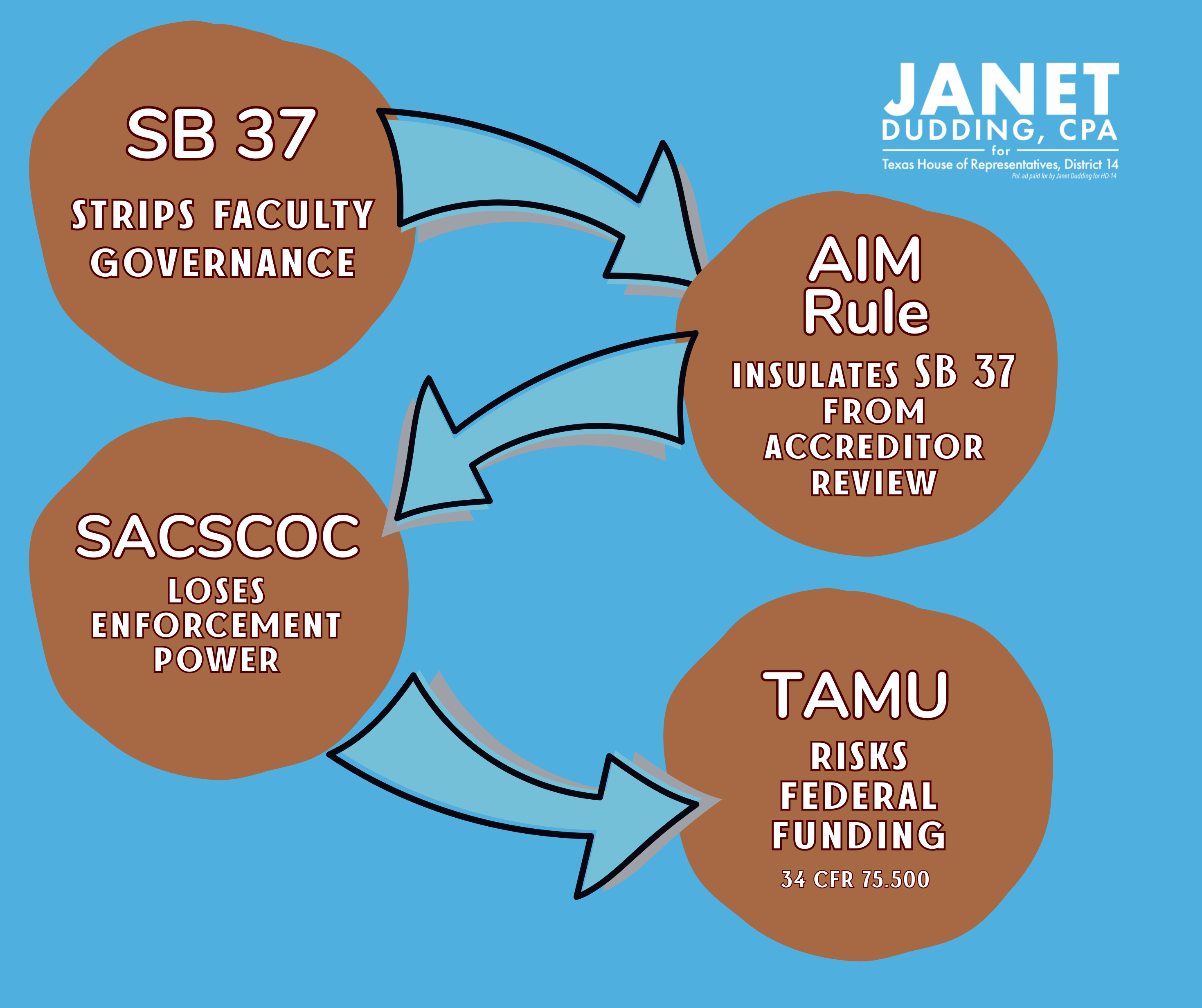
Texas Senate Bill 37, signed into law in June 2025, directly attacked shared governance at Texas public universities. It gave university presidents the power to appoint faculty senate officers—the very people meant to provide independent oversight—and stripped faculty of final authority over curriculum.
SACSCOC’s standards require meaningful shared governance, meaning SB 37 created a direct tension with A&M’s accreditation. Normally, SACSCOC would resolve that tension using its established standards. The AIM Rule changes that equation by insulating state laws like SB 37 from meaningful accreditor review. The result is a one-two punch: Texas strips faculty governance, then Washington ensures nobody with enforcement power can say a word about it.
The Committee That Wrote This Rule Had No Faculty On It
Federal rulemaking of this magnitude is supposed to go through a process called “negotiated rulemaking.” The intent is simple: the people most affected by a regulation should have a voice in writing it.
The AIM Negotiated Rulemaking Committee met in April and May 2026 and reached consensus on May 21, 2026. The problem? Not a single member of that committee represented faculty.
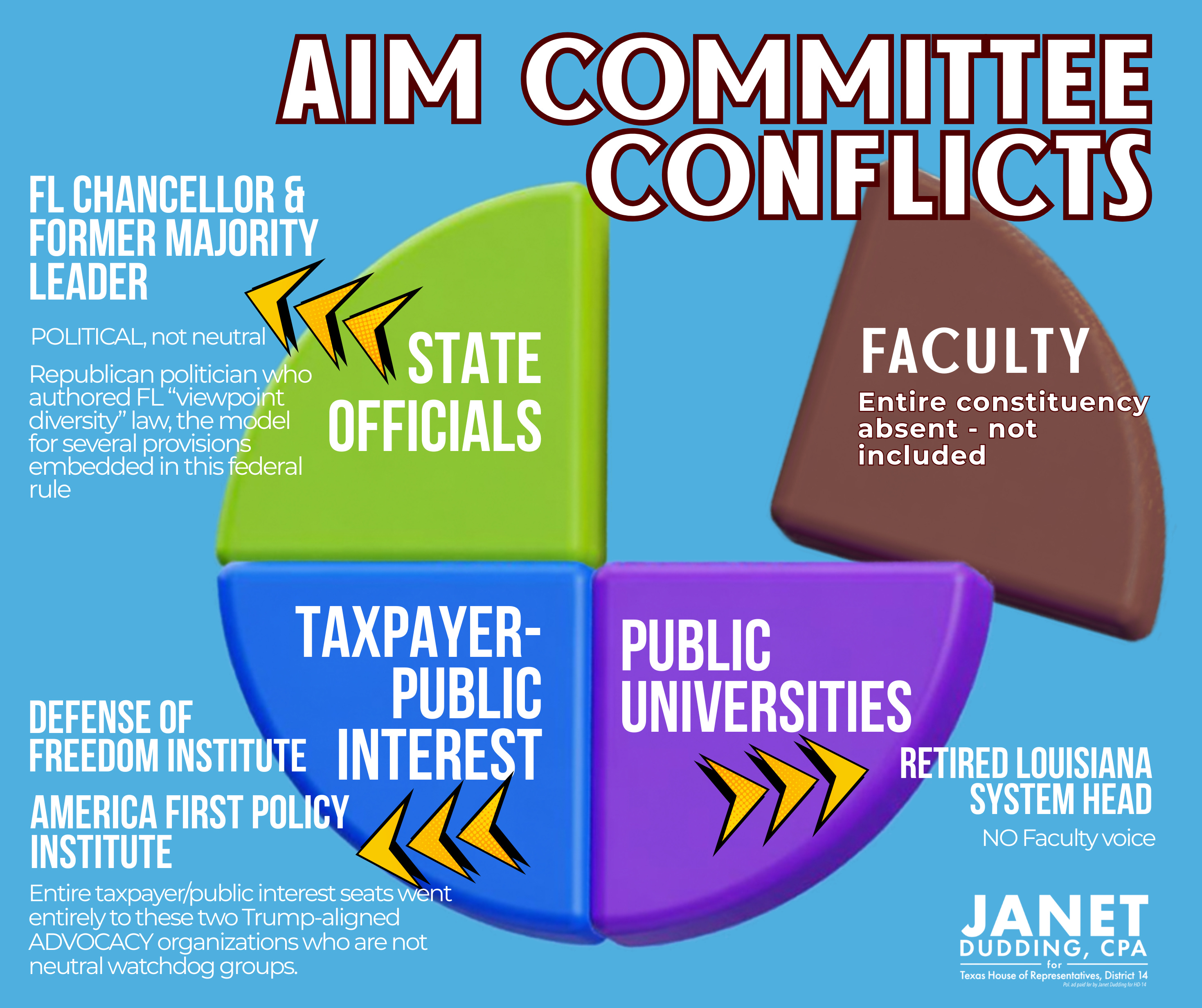
The committee had seats for students, veterans, employers, and state officials, but no seat for the people who actually stand at the front of America’s classrooms. Furthermore, the seats that were filled carried staggering conflicts of interest:
State Officials seat: Held by Raymond Rodrigues, Chancellor of the State University System of Florida. Rodrigues authored Florida’s “viewpoint diversity” law — the direct model for several provisions embedded in the AIM Rule. His presence as a “neutral” state official was anything but neutral.
Taxpayer/Public Interest seats: Filled entirely by two Trump-aligned advocacy organizations: the America First Policy Institute and the Defense of Freedom Institute. These are not neutral watchdog groups. These are not neutral watchdogs; they are advocacy groups with explicit policy agendas.
Public Universities seat: Filled by a retired community college system head with no faculty voice and no representation from any major research university.
Even more shocking: SACSCOC—the accreditor covering the entire southeastern United States—was not on the committee. The entity most directly affected by this rule was denied a seat at the table.
The Legal Trap Hidden in the Rule’s Language
As a CPA, I read regulatory language for a living. When I look at three specific provisions of the AIM Rule, I see a pattern that, in my professional field, would be flagged as a structural failure. While I am not issuing a formal audit opinion, my professional training tells me that these provisions create a systemic vulnerability—one significant enough to potentially put federal funding and institutional legitimacy at risk.
§ 602.17: The “Consistency” Trap
The AIM Rule requires accreditors to apply their standards 'consistently.' That sounds reasonable, but the definition is a trap. It allows institutions to protect themselves from penalties for suppressing academic freedom—as long as they suppress *all* viewpoints equally. If an administration eliminates a program for ideological reasons, they can shield themselves from the accreditor by proving they eliminated other programs too. Symmetric suppression becomes a legal shield.
§ 602.23(j) + SB 37: The State Law Insulation Provision
This is where the rule becomes a weapon for Austin. If a state law (like SB 37) mandates a governance structure that undermines shared governance, and the AIM Rule prohibits accreditors from requiring universities to violate state law, then SB 37’s damage to Texas A&M becomes effectively immune from challenge. The last independent check on SB 37’s impact—the accreditor—is silenced.
§§ 600.11 and 602.28: Accreditor Shopping
These provisions enable 'regulatory arbitrage.' If an institution finds SACSCOC’s rigorous standards inconvenient, they can simply switch to a newer, less-established accreditor with weaker rules. The federal student aid dollars would follow them to the new, weaker accreditor. Texas A&M’s status—and the federal funding that depends on it—would no longer rest on decades of established rigor, but on who is willing to look the other way.
There Is Already a Federal Lawsuit
Faculty at Texas A&M are not waiting for the rulemaking process to play out. On September 17, 2026, the American Association of University Professors filed a Motion for Preliminary Injunction in the Southern District of Texas (AAUP v. Albritton, Case No. 4:26-cv-06268) to block Texas A&M’s November 2025 syllabi review policy — a policy that requires faculty to submit their course syllabi for administrative review before teaching them.
The declarations filed in support of that motion — from A&M professors including Leonard Bright (the lead plaintiff), Vanita Reddy, and Aaron George — describe in concrete, human terms what it feels like to teach under surveillance. These are your colleagues. These are people who chose Texas A&M because they believed in its mission.
You can read more about the case at aclu.org/cases/aaup-v-albritton.
What I Did About It Today
On behalf of myself, my family, faculty, staff, and students of Texas House District 14, I submitted a formal public comment to docket ED-2025-OPE-1042-0002. My comment raised four specific objections:
Committee bias: The negotiated rulemaking committee excluded faculty entirely, excluded SACSCOC, and included participants with direct conflicts of interest.
The consistency trap: § 602.17’s definition of “consistent application” could reward symmetric suppression of academic freedom.
State law insulation: § 602.23(j), combined with SB 37, would shield state-directed governance interference from accreditor review.
Accreditor shopping: §§ 600.11 and 602.28, read together, enable institutions to abandon rigorous accreditors in favor of weaker ones — with federal dollars following them out the door.
Under 34 CFR 75.500, violations of academic freedom and free speech protections can jeopardize federal funding. A&M receives billions in federal research grants and student financial aid. The combination of SB 37 and the AIM Rule creates a structural vulnerability that the university’s administration, its Board of Regents, and the Texas Legislature must take seriously—not as a political debate, but as a financial risk to the institution.
What You Can Do
The public comment period closed September 21, 2026. But the conversation doesn’t stop there. Here is how you can stay engaged:
Like, restack, and share this post with faculty, staff, graduate students, and anyone who cares about what happens inside Texas A&M’s classrooms
Follow AAUP v. Albritton — this case will likely produce significant rulings in the coming months
Contact your state representatives — including the candidates running to represent you in Austin — and ask where they stand on SB 37 and on accreditation independence. We know where Charles Schwertner and Paul Dyson stand on SB 37 — Schwertner sponsored that bill and Dyson voted yes on it.
Visit janetdudding4texas.com to learn more about my campaign and why academic freedom is the reason I’m running.
VOTE. The world has never been changed by bystanders. It has always, only ever, been changed by citizens who decided their voice mattered — and used it. This is your moment to use yours.
Early voting: October 19 - October 30.
Election day: November 3.
Academic freedom is not a partisan issue. It is the precondition for everything else a university does — the research that cures diseases, the teaching that produces engineers and nurses and accountants and historians, the inquiry that keeps a society honest about itself. When it is threatened, everyone loses.
I will keep watching this rule. I will keep showing up. And I will keep talking to you about it.
While we’re talking about Action
1. You have until October 5 to register to vote in the November 3 election. There is no online voter registration in Texas. Head to votetexas.gov, print the application, sign it, mail it or drop it off. If you’re already registered, use the “Am I Registered?” tool to double-check.
If you’re a US citizen and sleep in Brazos County, Texas, you can vote in Brazos County, Texas, if you register in Brazos County, Texas - and Bryan-College Station-Texas A&M & Blinn, we need your vote! The MSC (Memorial Student Center) on Texas A&M Campus is an early vote site from October 19 - October 30. The MSC is an Election Day site, too. Please register where you reside (sleep) and then VOTE!
2. Early voting in Texas runs October 19 through October 30 and includes the Saturday and Sunday of October 24 and 25. Make a plan to vote early to avoid any issues on election day.
3. On November 3, vote James Talarico for U.S. Senate against Ken Paxton. Vote Caitlin Rourk for U.S. Congress District 10 against Elon Musk’s personal attorney, Gober. Vote Gina Hinojosa for Governor against Greg Abbott. Vote Vikki Goodwin for Lieutenant Governor against Dan Patrick. Vote Nathan Johnson for Attorney General against MAGA Mayes Middleton. Vote Sarah Eckhardt for Texas Comptroller of Public Accounts against Don Huffines, the current owner of Epstein’s Zorro Ranch who is closely tied to billionaire donors Tim Dunn and Farris Wilks. Vote Ben Flores for Land Commissioner. Vote Jon Rosenthal for Railroad Commissioner against Bo French. Vote Clayton Tucker for Agriculture Commissioner.
Vote Janet Dudding for Texas House District 14 . Vote Paul Thomasson for Texas Senate District 5, and pay attention to your Texas Judicial races.
4. These are the Judicial candidates to vote for this midterm election:
Chief Justice Supreme Court: Maggie Ellis
Justice, Supreme Court, Place 2: Chari Kelly
Justice, Supreme Court, Place 7: Kristen Hawkins
Justice, Supreme Court, Place 8: Gisela D Triana
Judge, Court of Criminal Appeals, Place 3: Okay Anyiam
Judge, Court of Criminal Appeals, Place 4: Audra Riley
Judge, Court of Criminal Appeals, Place 9: Holly Taylor
Chief Justice, 15th Court of Appeals District: Jerry Zimmerman
Justice, 15th Court of Appeals District, Place 2: Tom Baker
Justice, 15th Court of Appeals District, Place 3: Marc Meyer
5. In Brazos County, there are only two county races that are contested. Brazos County Precinct 4 Commissioner, vote Wanda Watson. Brazos County Precinct 4 Constable, vote Hezekiah Carter, Jr.
Janet Dudding, CPA, is a candidate for Texas House District 14, which includes Texas A&M University. She is a governmental CPA and a lifelong advocate for academic freedom. This post reflects her personal views and analysis. Pol. ad paid for by Janet Dudding for HD-14.